SAAT
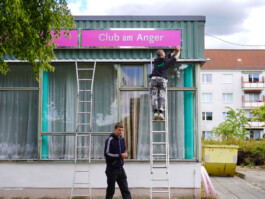
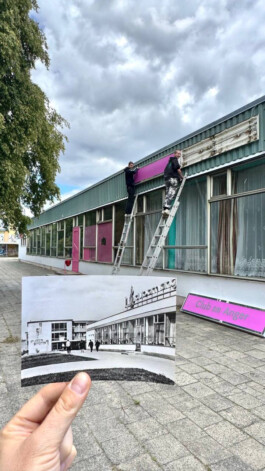
A scholarship programme in collaboration with the Neuzelle Local Authority and the Eisenhüttenstädter Wohnungsbaugenossenschaft e.G., as part of the research project ‘Of Harvest Workers and Spatial Pioneers – Strategies for Cooperation between Art Colleges and Stakeholders in Rural Areas’.
It was January when eight students studying painting, graphic design and architecture at the art college in Berlin-Weißensee were sent to Neulewin in the Oderbruch region. They were put up in the village, given a studio, and set about surveying a derelict building that was to serve as a cultural centre in future, as well as planning a festival for the summer in which the whole village would be involved. After a month, they returned to Berlin. The festival took place as planned – in the summer of 1960 – and the art college signed a cooperation agreement with the village.
One of the students – Erika Stürmer-Alex – began travelling to the Oderbruch with amateur artists and organised a small house to serve as a base for artistic exploration. The graphic designer Dieter Kahl arranged for students from the university to use vacant farmsteads. It is these networks that form the roots of the rich cultural life in the Oderbruch today.
Against a backdrop of very different circumstances – in Berlin, capital-driven urban development is devouring the last remaining spaces for creative experimentation, whilst in Eisenhüttenstadt, for example, the consequences of deindustrialisation continue to tear gaps in the city, the community and families – we wish to build on the practice of the Weißensee Academy of Art in the 1960s: Graduates of creative arts programmes should have the opportunity to contribute their skills to cultural initiatives across the region.
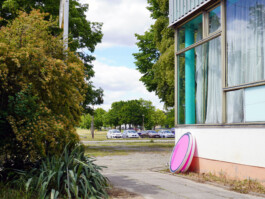
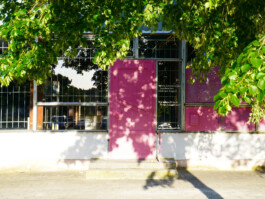
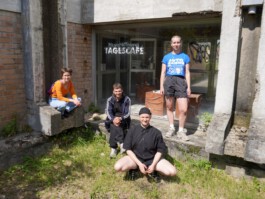
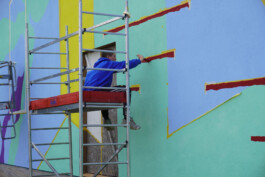
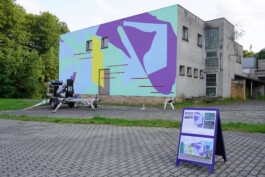
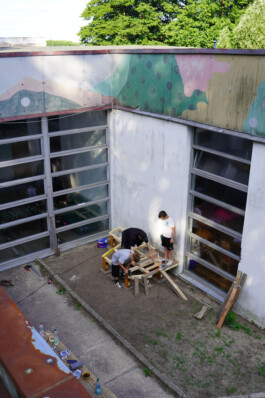
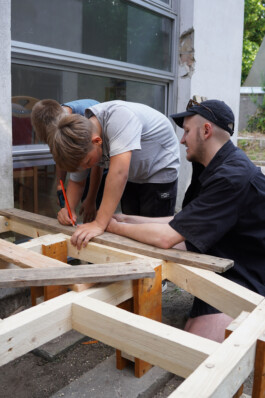
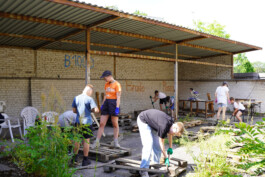
In June and July 2025, four graduates were awarded a grant to support the revitalisation of derelict cultural centres in Neuzelle and Eisenhüttenstadt.
people involved:
Carla Baumeister
Enzo Agger
Konstantin Hildebrandt
Lene Zech
supported by:
Steffen Schuhmann