kolonialokal – wir packen aus!
Collections of objects from colonial contexts are not limited to Berlin, Hamburg or Leipzig.
Collections of objects from colonial contexts are not only found in Berlin, Hamburg or Leipzig. They also exist in rural areas. Take Beeskow, for example. The museum there was founded in 1906 to tell the story of the region. Today, however, the collection also includes objects from northern Europe, the South Pacific and Africa, particularly from Namibia, the former colony of German South-West Africa. This raises questions: How do you bring to light what is hidden in public museums? How can the debate about the future of such collections be shaped? And what do they actually have to do with big-game hunting, the disappearance of Sorbian place names, a missing Australian explorer, denazification in a small town and the colonial goods shops in the villages?
Together with the ethnologist Dr Kerstin Volker-Saad, we researched the background to the collection. This research formed the basis for the exhibition in Beeskow, which we conceived and designed. It illustrates how global upheavals are reflected in local contexts and encourages people to engage with German colonial history within a regional and family context.
Research
The starting point for our research was an examination of the museum’s collection and accession registers. Of particular interest was a collection that came to the museum in 1953 as a donation from a Mr Hans Meyer from the village of Mochlitz. Through research in the Beeskow Municipal Archives, the Oder-Spree District Archives and the Brandenburg State Archives, we were able to identify Meyer. We managed to track down his book about a hunting expedition to the Himalayas, ‘selfies’ with animals he had bagged, and even some of Meyer’s distant relatives. Apparently, as a big-game hunter, he had travelled to Russia, Kenya, India, Sudan and Namibia before 1918. This suggests that his collection originated in a colonial context.
Exhibition design and graphics
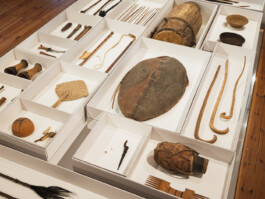
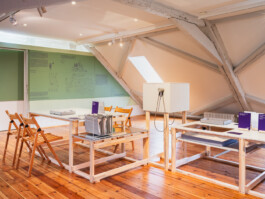
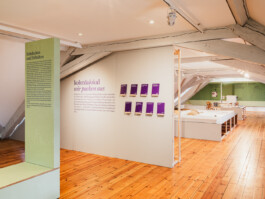
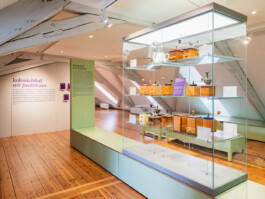
Visitors to the exhibition are first greeted by a display case containing coffee grinders. These illustrate how colonialism shaped everyday culture in Germany – right down to the villages of the Mark Brandenburg. However, the focus of the exhibition is on the 74 objects that came to Beeskow via Hans Meyer and other collectors. We are displaying them in acid-free archive boxes. After the exhibition, these can be used to store or transport the objects under appropriate conservation conditions. Audio stations, the museum’s visitor log and files containing transcripts from our research offer the opportunity to delve deeper into the background. A wall-sized graphic illustrates the composition and history of the Beeskow collection.
Come to Beeskow!
The exhibition ‘kolonialokal – wir packen aus’ was developed as a collaboration between the Museum Oder-Spree, the Museumsverband des Landes Brandenburg e.V. and the studio mut.und.anmut at the Weißensee Academy of Art, Berlin. It was supported by the German Lost Art Foundation and Kulturland Brandenburg. It can be seen at the Museum Oder-Spree at Burg Beeskow until 31 December 2024.
The creative work on the project involved a wide range of media and techniques. First, based on the information and concepts developed during the research phase, the students wrote texts and accompanying material. This factual content was then processed in the form of various graphic media.
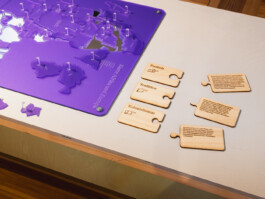
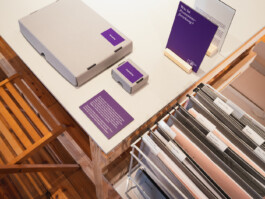
Within the exhibition, these primarily consist of an introductory text, a wall-sized illustrated infographic illustrating the situation of the collection, and 19 information panels, each featuring a question on the front and an explanatory text on the back, which address the theme in simple terms. In addition, postcards, leaflets and posters were produced for public relations purposes, the design of which incorporates the exhibition title ‘kolonialokal – wir packen aus’.
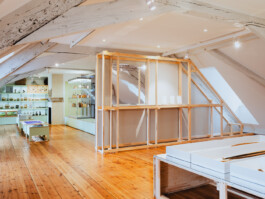
For the exhibition itself, a concept was implemented which, by dividing the space, first introduces visitors to the theme and then deliberately leads them into the wider part of the room where the museum’s colonial collection is on display. The 74 objects on display, presented in acid-free archive boxes – which will later also be used for the conservation storage of the collection – are accompanied by information on the research, provenance history and future considerations. Audio stations, inventory books and reading areas provide space for visitors to engage independently with this complex topic.
To illustrate the region’s relationship with colonialism, historical postcards depicting colonial goods shops were collected, along with old coffee grinders from private households obtained through a call for donations. These were then exhibited in the run-up to the exhibition to establish a historical and economic link with the district.
In addition to the exhibition at the museum or-spree, workshops were also planned with schools to address the history and consequences of colonialism in secondary schools, as such topics have so far been largely absent from the curricula. As part of the museum’s educational programme, a game was also developed to address the unjust distribution of objects from the colonial era.
people involved:
Anna Wolf
Bar Esh
Bruno Giannori
Konrad Adam Modrzejewski
Konstatin Hildebrandt
Lore Elstermann
Pau Mantel
Polina Ryman
Steffen Schuhmann
supported by:
Caroline Lei
Thilo Albers